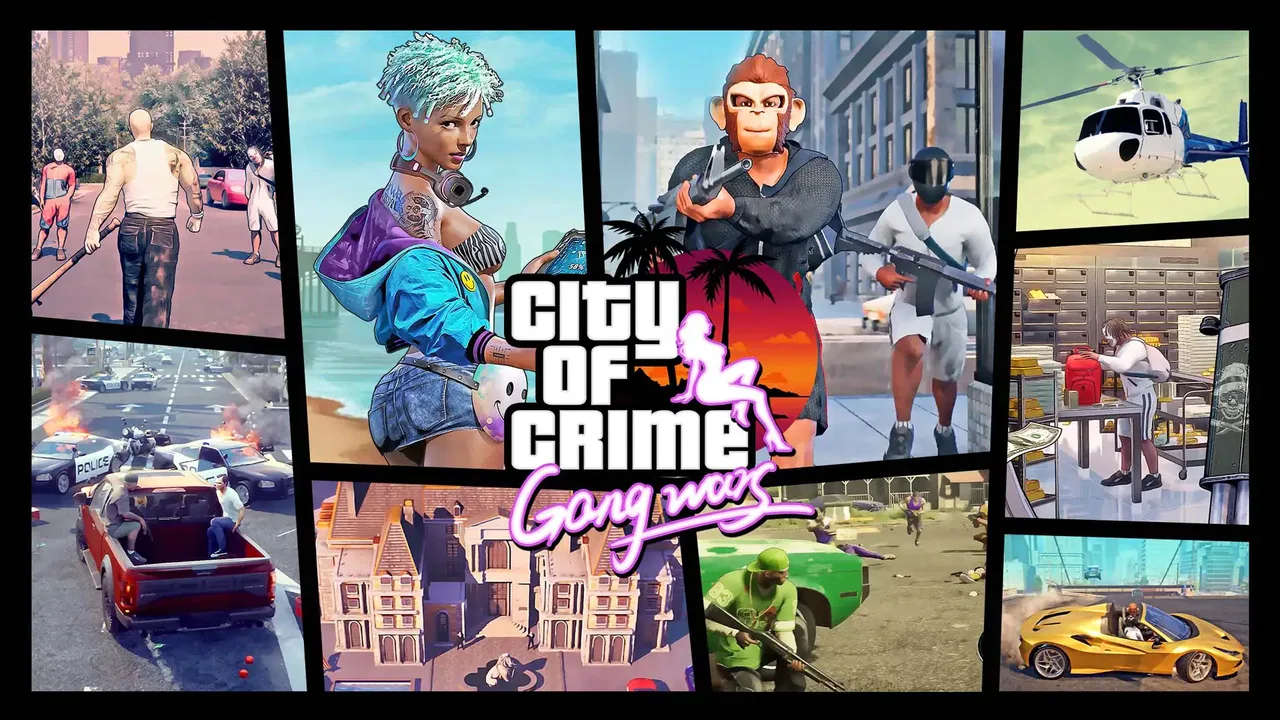
City of Crime: Gang Wars
- 4.4
- Rating
- 10.00M
- Installs
- Free
- Price

 Analysis by App-foxy
I spent time with City of Crime: Gang Wars as a mobile strategy game, and my first impression was that it wants to keep me making decisions rather than simply watching battles unfold. Its setting is built around a dangerous city where conflict can begin quickly, so the mood is more aggressive than what I would expect from a calm base-building game. I found the appeal in balancing expansion, preparation, and the timing of confrontations instead of treating every encounter as a simple button press.
That focus makes it easy to understand why the game has attracted a large audience. It is free to download, has passed ten million installs, and holds a 4.4 average from roughly 294 thousand ratings. Those figures suggest a well-established player base, but they do not automatically make it suitable for everyone. The mature 17+ rating matters here: the criminal-city theme and violent atmosphere are central to the experience, not background decoration.
CrushGameTechnologyLimited is the developer behind the game, which was released on February 8, 2022. I tested it with the mindset of someone deciding whether to keep it installed, not just whether the opening minutes were entertaining. My conclusion is fairly clear: it is a better fit for players who enjoy long-term strategy, competitive pressure, and regular planning than for anyone looking for a short, self-contained game with a quiet pace.
You May Also Like

 Blood Strike: 2.5 Anniversary
Blood Strike’s Loadouts Turn Every Drop Into a Tactical Gamble
A close look at Blood Strike’s custom loadouts: how fast access to signature weapons reshapes its battle royale rhythm, rewards preparation, and narrows the gap between fights.

 Pandora - Music & Podcasts
Pandora’s Music Is Easy to Start, but Harder to Recover
Pandora’s strength is its low-effort path from a seed to a station. Its weak spot is how much confidence it asks you to place in connection, setup, and quiet recovery.

 8 Ball Pool
 Is Built on Rivalries, Rematches, and Routine
A close look at the rivalries, rematches, shared routines, and unanswered safety questions that turn a quick pool match into a persistent mobile community.

 Samsung Music
’s Quiet Strength Is Playing What You Already Own
Its reach comes less from spectacle than from dependable access to a personal library. That simplicity is both the app’s strongest retention engine and its ceiling.

 AccuWeather: Weather Radar
AccuWeather Review: A Quick, Clear Forecast for Everyday Decisions
For everyday plans, the best forecast is the one you can understand quickly. AccuWeather makes rain timing, radar, and local conditions easy to act on, with a few trade-offs.

 Hill Climb Racing
Why Hill Climb Racing Still Turns Crashes Into One More Run
A tiny car, a bumpy hill and one more upgrade: Hill Climb Racing keeps resurfacing because its simple chaos makes every near-miss feel personal.
More From Our News Desk



How the current version feels to play
I find the current version easiest to approach when I treat each visit as one small planning step, rather than trying to force a major breakthrough every time I open the game. That habit also makes it clearer whether the available choices are keeping me engaged or turning into routine. From there, I look at the update position as context for how I’d judge a game meant to hold a player’s attention over time.
A strategy game built around pressure
The strongest part of the experience is the way the city setting gives ordinary decisions a sense of urgency. In a typical strategy game, I can often build at my own pace and treat combat as an occasional event. Here, the atmosphere encourages me to think about what might happen after every improvement. Expanding without preparing can leave me feeling exposed, while focusing only on defense can make progress feel slow.
That tension is useful because it gives routine actions a purpose. I am not just collecting resources or improving a location because the interface tells me to. I am trying to create enough stability to handle the next conflict. Even when the game is not showing a dramatic fight, the possibility of one affects how I approach the next decision.
I also noticed that the game works best when I play in short, deliberate sessions. A quick visit can be enough to check progress, make a useful upgrade, or review what needs attention. Longer sessions are more satisfying when I already have a plan, such as strengthening a weak part of my position before pushing forward. Without that plan, it is easy to tap through tasks and lose sight of the larger strategy.
Why the city theme makes a difference
The urban crime setting is more than a visual wrapper. It changes the tone of the choices. Progress feels less like developing a peaceful settlement and more like trying to gain influence in a place where control is always contested. That makes the game stand apart from fantasy kingdoms, science-fiction colonies, and historical empire builders, even though players coming from those genres will recognize the broad strategic rhythm.
I appreciated that the theme gives the game a sharper identity, but it also narrows its audience. If you dislike gang-centered stories, criminal imagery, or a mature presentation, the underlying strategy systems may not be enough to make the game comfortable. I would not recommend it as a family-friendly strategy option simply because it is available on a phone.
The first session and the learning curve
The opening experience is approachable enough for someone familiar with mobile strategy games, but newcomers should expect to learn by connecting several decisions together. An upgrade rarely feels isolated. It affects what I can do next, how quickly I can recover from setbacks, and whether I am ready for a more demanding confrontation.
My practical advice is to resist spending every available resource immediately. I found it more useful to keep a reserve for the next meaningful step than to improve whichever option happened to be available first. This is one of the less obvious habits that helps: treat spare resources as strategic flexibility, not as a signal to upgrade at once.
Another useful approach is to pause before committing to an aggressive move. The game’s fast-conflict premise can encourage impulsive play, but rushing forward may create more problems than it solves. I got better results when I checked whether my current position could support the consequences of an attack instead of judging the move only by its immediate reward.
Playing in an everyday routine
A realistic use case is a player who has a few minutes during a commute, lunch break, or evening wind-down. I would open the game, review what had changed, finish a small improvement, and leave with a clear next objective. That pattern suits the mobile format better than trying to complete everything in one sitting.
For a heavier session, I would set aside more time and decide what kind of progress I wanted: development, preparation, or confrontation. Mixing all three without a priority can make the session feel busy but not especially productive. The game rewards a little self-discipline, especially when the surrounding atmosphere makes every conflict feel urgent.
What the update position tells me about the game
I read the current release as a useful point of reference, not a promise that every player will have the same experience: device performance and personal expectations still shape how it feels. For someone deciding whether to keep playing, I’d focus on whether the current build supports a steady, understandable routine and whether that routine remains enjoyable without spending. That leads naturally to the broader question of what an update can tell me about the game’s direction.
The current release in context
The current version is 1.2.176, and the game supports devices running Android 6.0 or later. That gives it a broad technical reach compared with games that require newer hardware or operating systems. I would still judge performance on the specific phone or tablet rather than assuming that minimum compatibility guarantees an identical experience everywhere.
The version number also tells me that this is not a newly launched experiment. It has had time to develop beyond its original release, and existing players are likely approaching it with expectations shaped by earlier versions. New users benefit from entering a more mature product, while returning users will naturally pay closer attention to whether the latest build improves the parts they already care about.
I prefer to look at version changes in practical terms. The important question is not whether the number has increased, but whether the current build makes daily play smoother, keeps progression understandable, and maintains a fair relationship between planning and spending. Those are the areas that determine whether a long-term strategy game remains enjoyable.
How changes affect someone already playing
For an existing player, an updated build can alter the feel of familiar routines even when the central idea remains the same. A small adjustment to pacing, balance, or progression can change which decisions seem worthwhile. That is why I would not judge an update only by the first session after installing it. I would compare the way I plan, recover, and choose confrontations over several visits.
New players have a different advantage: they can learn the current version without having to unlearn old habits. I would still recommend taking early progress slowly enough to understand the game’s priorities. A player who copies an old approach from another strategy title may find that the city setting demands a different balance between growth and readiness.
The game’s update history should also be viewed alongside its monetization. It is free to play, but in-app purchases range from $0.99 to $199.99 per item. That is a wide range, and it is the main reason I would advise setting a personal spending limit before becoming invested in the competitive side. Free access makes it easy to try, but long-term commitment can create pressure if I start treating purchases as a solution to every delay.
Where spending changes the decision-making
I do not think the presence of purchases automatically ruins the strategy. The problem is that spending can weaken the satisfaction of solving a difficult situation through planning. If a player can regularly bypass friction, the game may become less about making careful choices and more about deciding when to pay for convenience or acceleration.
My preferred way to approach it is to play without purchasing anything at first. That gives me time to learn whether the basic loop is enjoyable and whether the waiting or progression pace fits my routine. If I later choose to spend, I would do so for a clearly defined reason rather than because I felt rushed by the game’s atmosphere.
This is also where City of Crime: Gang Wars differs from a traditional premium strategy game. A paid, self-contained alternative may offer a cleaner progression path and fewer spending decisions, while this game offers the convenience of free entry and a more ongoing structure. Players should choose based on what kind of commitment they want, not only on the download price.
Remaining gaps and friction points
The biggest limitation for me is that the game can demand patience without always making that patience feel rewarding. Long-term strategy depends on delayed results, but mobile design can make delays feel like obstacles placed between the player and the next interesting decision. When I had a meaningful plan, waiting felt manageable. When I did not, the same pacing felt like routine maintenance.
There is also a risk of repetition. The city-conflict theme gives the game personality, but repeated strategic cycles can begin to feel familiar if I approach every session in the same way. The solution is to vary my priorities and avoid reducing the experience to a checklist. That does not remove the limitation, but it makes the available decision-making feel more deliberate.
Another point is the mature presentation. The 17+ age rating is not a minor label that I would ignore when recommending the game. Parents looking for a strategy title for younger players should choose something else, and adults who prefer less violent themes may find the setting distracting rather than engaging. The game’s identity depends on its darker tone, so this is a genuine suitability issue.
I would also be cautious about installing it on a device that is barely supported by the operating-system requirement. Android 6.0 is the minimum, but a device meeting only that threshold may not deliver the same comfort as a newer phone. Strategy games often involve repeated menus and extended sessions, so responsiveness matters even when the individual actions are not graphically intense.
Who should try it, and who should skip it
I would recommend it to players who enjoy mobile strategy with a criminal-city setting, like building toward larger goals, and do not mind returning regularly. It is especially suitable for someone who enjoys thinking several steps ahead and can accept that progress may be gradual. The free price makes it easy to test that fit without committing money immediately.
I would skip it if I wanted a complete campaign that I could finish in a few evenings. I would also look elsewhere if I dislike competitive pressure, mature themes, or in-app purchase systems. A slower, premium strategy game is likely a better choice for someone who values predictable progression and wants every major decision to come from gameplay rather than optional spending.
Players who mainly want instant action should be careful too. Although the game presents a city where conflict can erupt quickly, its long-term appeal comes from preparation and development. The most satisfying moments are connected to decisions made earlier, not just the visual excitement of a single confrontation.
What I would watch during future updates
If I were continuing to play, I would watch how the game handles balance between free progress and paid advantages. That relationship determines whether careful planning remains meaningful for players who do not spend. I would also pay attention to whether updates keep the daily routine varied enough to prevent the city from feeling like a sequence of identical chores.
I would look for improvements that make strategic consequences easier to understand. Clear feedback helps me learn from a poor decision instead of simply feeling that progress slowed down. For a game built around conflict, the best updates should make preparation feel more intelligent, not merely make the next confrontation arrive faster.
Finally, I would judge future versions by their effect on established players as well as newcomers. A change that makes the opening friendlier is useful, but veteran players also need reasons to rethink their habits without having their previous progress feel invalidated. That balance is difficult, and it will shape whether the game remains a long-term recommendation.
My final recommendation
After playing it, I see City of Crime: Gang Wars as a committed mobile strategy experience rather than a casual crime-themed diversion. Its strongest quality is the connection between the setting and the decision-making: expansion, preparation, and conflict all feel related. I enjoyed it most when I gave myself a specific objective and accepted that good progress would take more than one visit.
Its weaknesses are equally important. The mature subject matter limits its audience, the long-term structure can become repetitive, and the broad range of optional purchase prices means I would approach the game with a spending boundary already in mind. Those issues do not make it a bad game, but they do make the recommendation conditional.
For the right player, the free download is a worthwhile trial. Start slowly, keep resources available for meaningful choices, and do not let the fast-conflict mood push you into decisions you have not prepared for. If you enjoy that balance, the game can become a regular strategic routine. If you want a calmer, finite, or fully premium alternative, I would choose a different style of strategy game instead.
FAQs for City of Crime: Gang Wars
01What is City of Crime: Gang Wars about?
City of Crime: Gang Wars is a crime-themed strategy and role-playing game in which you build an underground empire, recruit gang members, expand your territory, and compete against rival factions. Gameplay combines city development, resource management, missions, character upgrades, and real-time or asynchronous multiplayer activities. It is designed for players who enjoy organized progression, urban gang narratives, and competitive alliance-based events.
02Can City of Crime: Gang Wars be played offline?
The game generally requires an active internet connection because many of its main systems depend on online servers. Progress synchronization, events, alliance features, competitive battles, purchases, and content updates are handled online. Although some menus or previously loaded elements may open briefly without a connection, you should not expect a complete offline experience. A stable Wi-Fi or mobile data connection is recommended for reliable gameplay.
03Is City of Crime: Gang Wars free to download and play?
City of Crime: Gang Wars is typically free to download, but it includes optional in-app purchases. These purchases can provide premium currency, speed up construction or upgrades, unlock useful resources, and support faster progression. You can play without spending money, although progress may take longer and competitive events can feel more demanding. Parents should review purchase settings, especially if children use the device.
04Does City of Crime: Gang Wars contain violence or mature content?
The game uses a crime and gang-war setting, so its story and presentation include references to organized crime, weapons, conflict, intimidation, and territorial battles. The violence is generally presented in a stylized, game-oriented way rather than as a realistic simulation, but the mature themes may not be suitable for young children. Check the official age rating in your region before downloading and consider the game’s chat features.
05What should I know about multiplayer and alliances?
Multiplayer is an important part of City of Crime: Gang Wars. You can interact with other players, join or create alliances, participate in group events, compete for territory, and coordinate attacks or defensive strategies. These systems add depth and provide useful rewards, but they also make progress more dependent on regular activity and teamwork. Online chat may expose players to unknown users, so privacy and parental controls are worth reviewing.
Pros
- Large city map with plenty of areas to explore and missions to complete.
- Multiple upgrade paths for characters
- weapons
- vehicles
- and gang facilities.
- Competitive gang battles add variety beyond the main story missions.
- Regular events and rewards can keep progression feeling active over time.
- Stylized graphics and dramatic effects suit the crime-themed setting.
Cons
- Energy and upgrade timers can slow progress during longer play sessions.
- Many upgrades and menus may feel overwhelming for new players.
- Online features require a stable connection to work reliably.
- Higher-level content can become heavily dependent on resource grinding.
- The mature crime theme may not be appropriate for younger players.

City of Crime: Gang Wars
Gallery